
.png)
Talking about San Miguel de Allende without talking about the Parroquia of San Miguel Arcángel is simply impossible. Not only because its silhouette dominates the horizon of the historic center and has become the most recognizable image of the city, but because it concentrates centuries of history, faith, collective identity, and an unusual capacity for transformation.
The parish is not an isolated monument or a vestige of the past: it is a living presence that accompanies the daily rhythm of San Miguel for generations. Anyone who lives here soon understands that the parish is not only visited; it is inhabited, surrounded, observed, and naturally integrated into daily life.
Origins and evolution
The origin of the parish dates back to the 17th century, when San Miguel was still a strategic villa on the Camino Real de Tierra Adentro. At that time, the temple was modest and sober, built according to the canons of New Spanish colonial architecture. For more than two centuries, its facade was functional and contained, in harmony with the architectural language of its time.
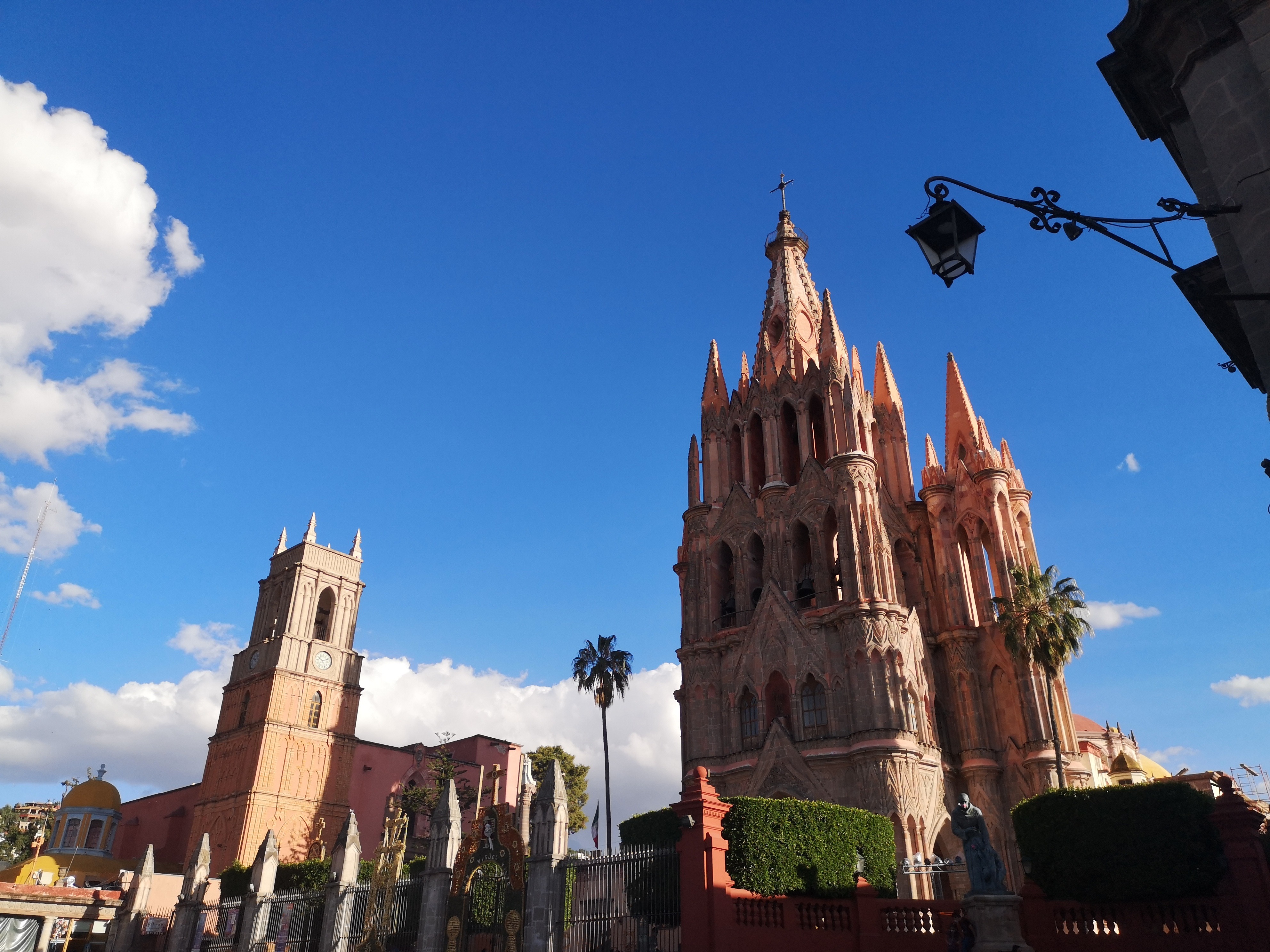
However, at the end of the 19th century, one of the most audacious and symbolic gestures in the city's urban history occurred. The master stonemason Zeferino Gutiérrez, originally from the region and without formal academic training in European architecture, assumed the task of transforming the facade of the temple. Inspired by engravings, postcards, and visual references of European Gothic cathedrals, he reinterpreted that imaginary from his own sensitivity and context.
The result was a unique neo-Gothic facade in Mexico: expressive, vertical, almost dreamlike, built in local pink quarry. It was not a literal copy, but a deeply personal and regional reinterpretation, where the European ideal merges with local craft and Mexican identity.
This transformation marked a before and after for San Miguel de Allende. The parish ceased to be solely a temple to become a visual and emotional symbol of the city.
More than a temple
Reducing the Parroquia of San Miguel Arcángel to its religious function would be falling short. Over time, it has been and continues to be:
- Social and community meeting point.
- Silent witness to processions, celebrations, farewells, and collective rituals.
- Emotional reference both for those born here and for those who arrived and decided to stay.
- Symbolic axis around which the life of the historic center is organized.
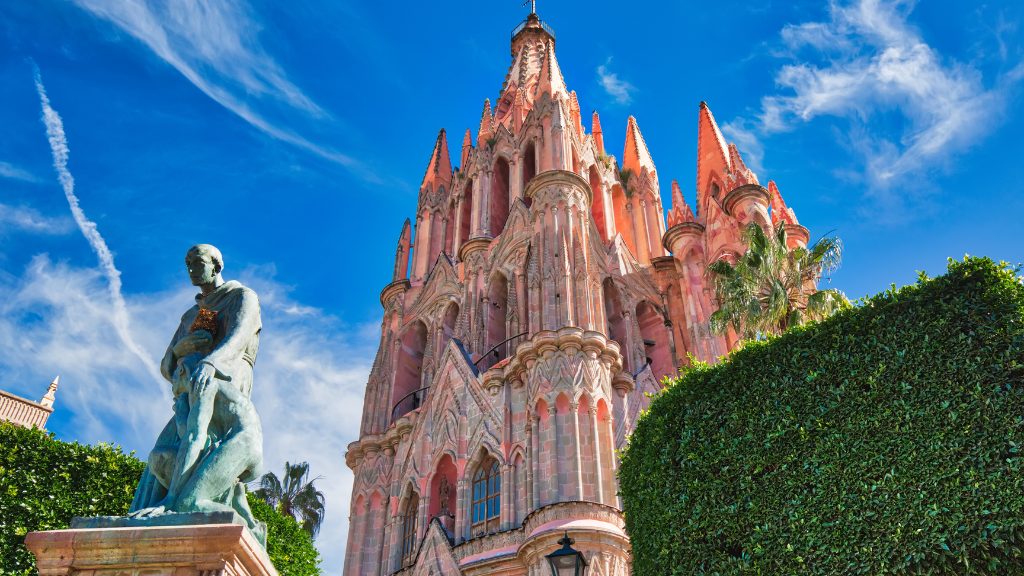
From the main plaza, the parish observes the passage of time with an almost immutable serenity. By day, it functions as a reference and orientation; it is the point from which distance, time, and travel are measured. At night, illuminated, it acquires an almost theatrical character, reminding us that San Miguel has known how to live with beauty without falling into excess or ostentation.
An interior that invites silence
The interior of the parish contrasts with the exuberance of its facade. The light, the altars, the height of the nave, and the arrangement of the space generate a contained, introspective atmosphere that invites a pause. Here, time seems to slow down, even for those who do not come with a religious intention.
.jpg)
“Interior of the Parroquia de San Miguel Arcángel, San Miguel de Allende” by Chanilim714 via Wikimedia Commons, license CC BY-SA 2.0. https://commons.wikimedia.org/
It is a space where faith, contemplation, and memory coexist. A place where decisive moments of life are celebrated and where one also learns to keep silent.
Deep meaning
The Parroquia of San Miguel Arcángel embodies something essential of the San Miguel spirit: the ability to reinvent oneself without losing the soul.
It is tradition and rupture at the same time. It is root and transformation. It is past reinterpreted from the present. That balanced tension between what remains and what evolves defines not only the parish, but the city itself.
Perhaps that is why many people who arrive in San Miguel feel that this place "stays with them." Because here, as in the parish, history is not a weight, but a base from which to build a life with meaning.
And that is exactly what many come looking for when they decide to live in San Miguel de Allende.